









Metal detector test pieces
Certified test pieces in ferrous, non-ferrous and stainless steel, in the sizes your HACCP plan specifies — marked, traceable and supplied with a certificate, as the standards require.
Ferrous · Non-ferrous · SS304 · SS316 — sphere diameters 1.0 mm to 12.0 mm
Test wands, test balls and test stick kits
Three formats cover almost every verification routine. Which one you use depends on how the product passes the detector.
Test wands
A certified sphere held in a marked rod and passed through the aperture by hand. The usual choice on tunnel detectors. Flexible wands are available where the aperture is small or awkward to reach.
Test balls
A loose sphere that travels with the product. Used on pipeline and free-fall systems, where a test port lets the piece go directly into the product stream.
Test stick kits
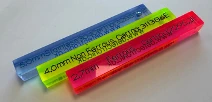
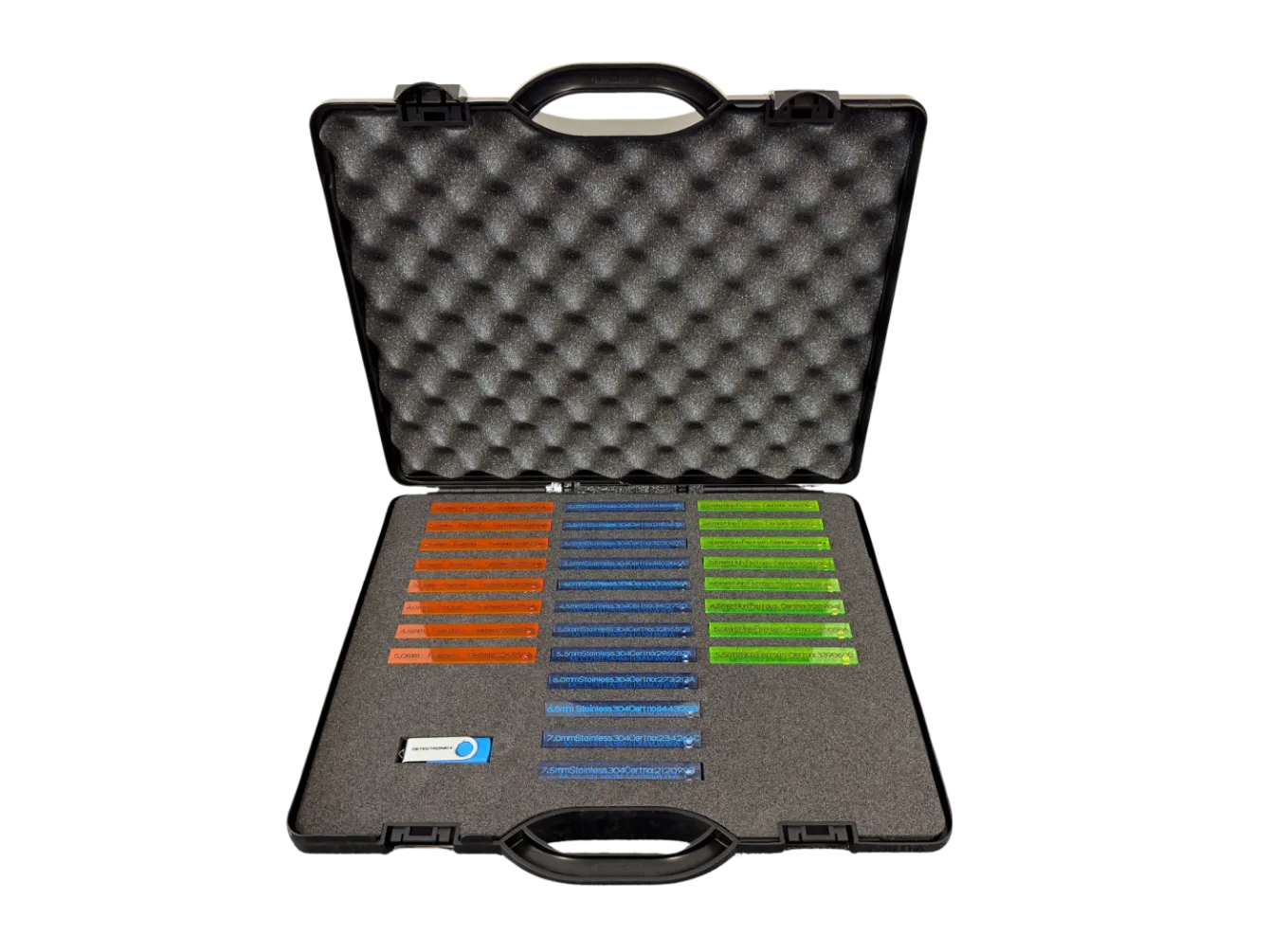
A foam-lined case holding a full range of certified sticks, colour-coded by material in graduated diameters, with the certificates supplied on a USB stick in the lid.
See the test stick kitEverything for every product programme sits in one box rather than in three drawers, and each stick is marked with its own certificate number — so the entry in the test log points at a specific, traceable piece.
Which material do you need?
The three materials behave differently in the detector field, so a pass on one does not demonstrate performance on the others. Most verification plans require one test piece of each.
Ferrous
Magnetic, and the easiest of the three for a detector to find. Usually the smallest sphere diameter named in the plan.
Non-ferrous
Typically brass or aluminium. Not magnetic, but conductive, so it is found on a different signal than ferrous.
Stainless steel
The hardest of the three to detect, and the one auditors focus on. SS316 is generally harder to find than SS304, which is why many plans name the grade specifically.
Worn or unmarked test pieces are a classic audit finding. The sphere diameter and material have to be documented, and the piece has to be identifiable. Replacing them costs very little. Arguing about them with an auditor does not.
Buy metal detector test pieces online
Already know the material and size you need? Order directly online.
Test wands, flexible test wands, test balls and complete test stick kits are stocked and ship without a quotation. Ferrous, non-ferrous and stainless steel, in sphere diameters from 1.0 mm to 12.0 mm, each supplied with its own certificate for your verification records.
Prices, stock and delivery are shown in the shop.
Talk to us before you order
Call or write when the specification is not settled: when you are matching test pieces to a detector you did not buy from us, when your HACCP, BRCGS or IFS plan names a sensitivity rather than a sphere size, or when an auditor has questioned the pieces you use today. Tell us the detector and the standard you are audited against, and we will tell you what to order.
+45 96 66 30 60
Monday to Friday, Danish office hours. Have your detector type and the sensitivity named in your test protocol ready if you can.
Email usservice@detectronic.com
Tell us the materials and diameters you need — ferrous, non-ferrous, SS304 or SS316 — or send us your current test protocol and we will tell you what it calls for.
Test piece questions we are asked most
What is a metal detector test piece?
A certified metal sphere of a known diameter and material, held in a wand or supplied as a free-running ball, used to prove that a metal detector still detects contamination at the sensitivity your quality plan requires.
Can I buy metal detector test pieces online?
Yes. Test wands, flexible test wands, test balls and complete test stick kits are stocked in the Detectronic webshop and can be ordered directly, with no quotation step. Every piece ships with its own certificate. If your procedure does not yet state a material and diameter, contact us before you order and we will confirm what your detector and your standard require.
Which metals do I have to test?
Ferrous, non-ferrous and stainless steel. The three behave differently in the detector field, so a pass on one does not demonstrate performance on the others. Most verification plans require one test piece of each.
What is the difference between SS304 and SS316 test pieces?
Both are austenitic stainless grades, but they do not behave identically in a detector field. SS316 is generally the harder of the two to detect, which is why many verification plans specify it as the stainless test material. Where your plan names a grade, keep using that grade: results are only comparable over time if the material stays the same.
What diameter should I use?
The size named in your HACCP or BRCGS plan. Where none is named, use the smallest sphere the detector reliably found at commissioning and keep using that size, so results stay comparable over time.
When should a test piece be replaced?
When the rod or carrier is cracked, when the sphere is loose or exposed, or when the certificate has expired under your own procedure. A damaged test piece invalidates the check it was used for.
Does each test piece come with a certificate?
Yes. Every piece is supplied with its own certificate identifying the sphere diameter and material, which is the document an auditor will ask to see.